
Latvia's
most-visited
national
portal,
rebuilt
in
five
weeks.
Designed for the decade that came after
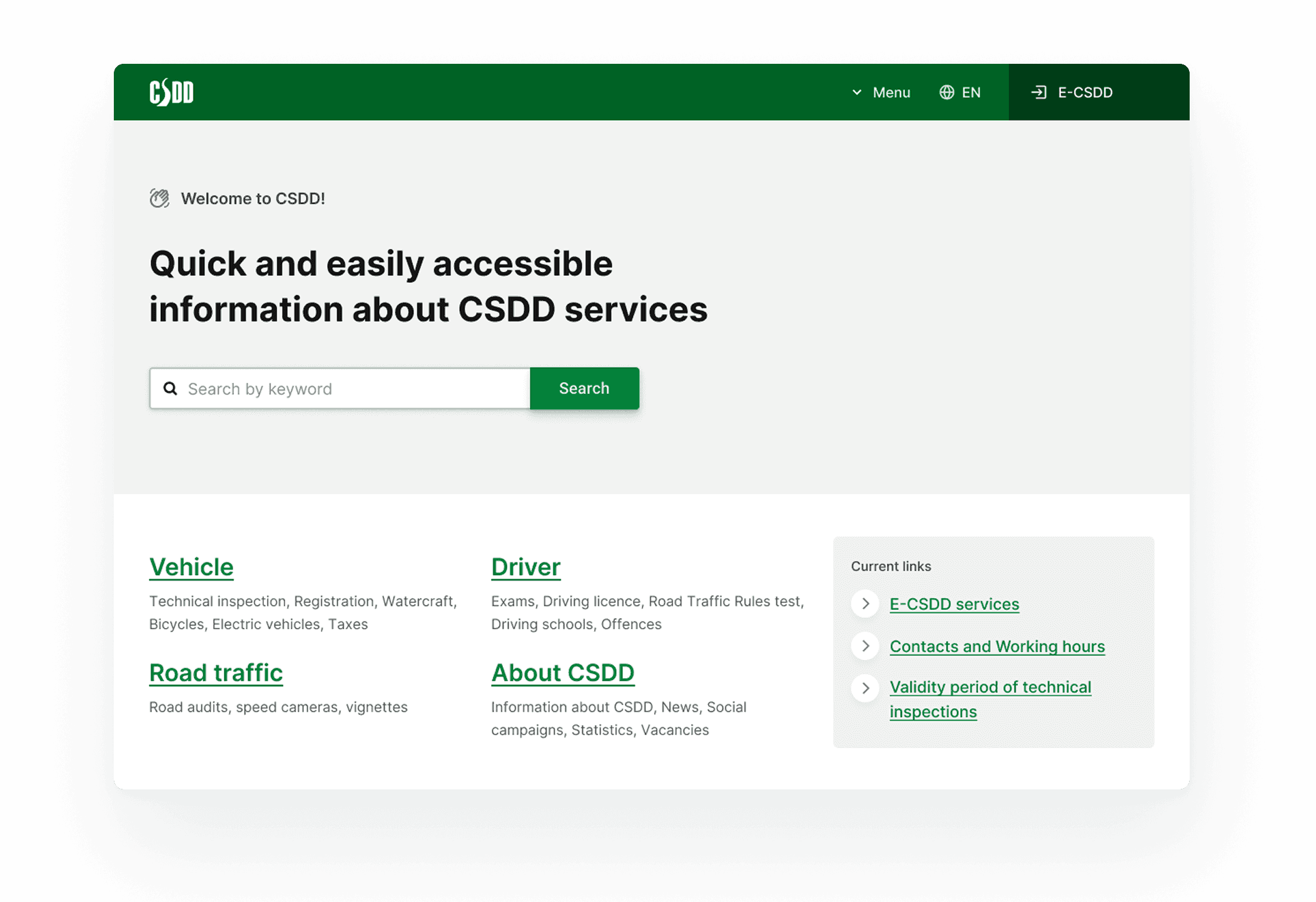
The hard part wasn't designing for five weeks. It was designing for the decade that came after.
Context
One platform, every Latvian driver
CSDD.lv is Latvia's Road Traffic Safety Directorate — the platform every Latvian driver, vehicle owner, and future license holder eventually has to use. Roughly 300,000 visits a month against a national population under two million — more than 17% of Latvia, monthly. Its audience spanned learner's-permit applicants to retirees checking vehicle-inspection dates, car dealers to first-time importers — one of the broadest civic user bases any Latvian digital product has.
In mid-2016, CSDD ran a competitive tender for a full redesign of the public-facing portal: 110+ unique page layouts, a search that returned zero results for most queries, and an accessibility baseline that excluded large segments of the audience. The delivery window was five weeks — kickoff to design handoff. Wrong Digital won the work on methodology, not deliverables: earlier that year I'd been pushing the agency toward a research-led, data-driven design practice, and by the time the CSDD tender opened, that approach was something we could demonstrate, not just describe. I led design alongside Jānis Veģis (UX research) and Ilze Grietēna (project management), supported by a small engineering team — covering five disciplines that would normally be split across three or five people: design strategy, research and usability testing, information architecture, interaction and UI design, and the design system handoff that had to outlive the engagement.
Before any design work started, we spent time aligning with CSDD on what the redesign actually needed to produce — not just a visual update, but a structural shift in how the site was organized.
Approach
Problem
The site was organized around how the institution thinks, not how citizens need to find things
Before
After
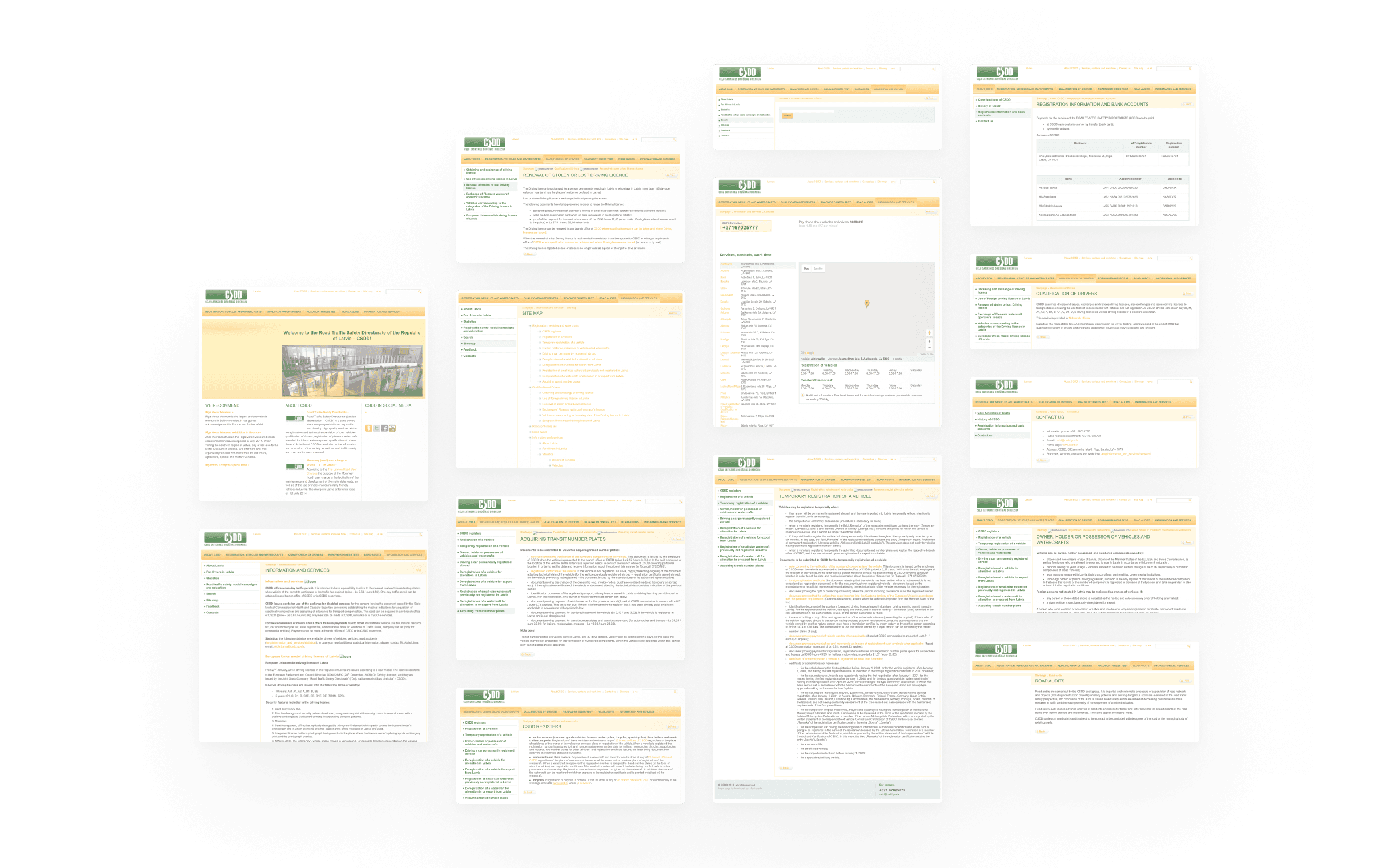
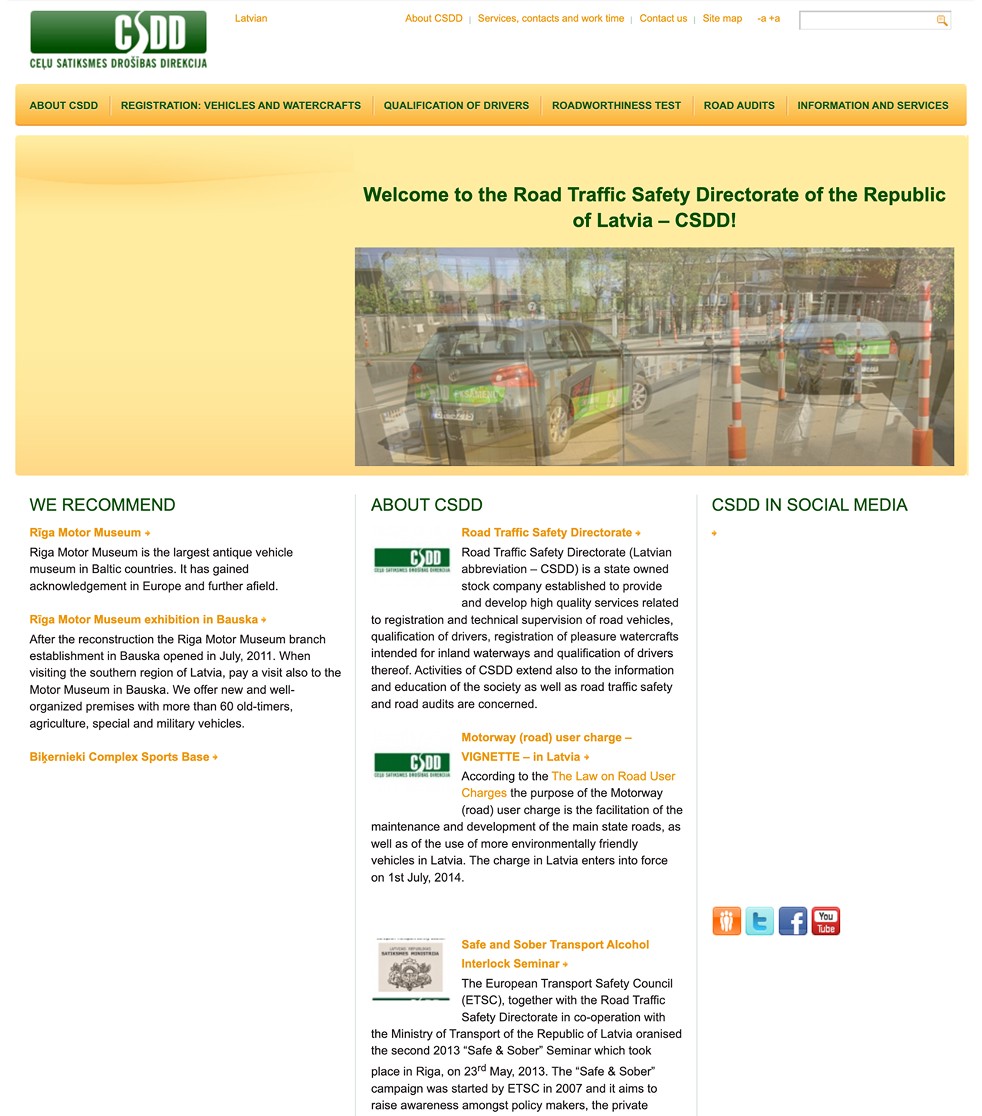
The existing CSDD.lv had grown the way most long-lived government portals grow: one department at a time, one page at a time, one feature layered on top of another until layouts piled up faster than anyone could maintain them. Research made clear almost immediately that the surface problems we saw — the broken search, the accessibility failures, the visual clutter — were all symptoms of a deeper structural issue.
What made these problems a single problem rather than four separate ones was the underlying cause: nothing on the site was organized for the person trying to find something. Everything was organized for the department that owned it. "Remove the institutional logic, reintroduce the citizen's logic" became the working thesis for the sprint.
Research & Insights
The drop-off patterns matched the institutional mismatch
to do one of the Core tasks
Finding inspection station Address
and Opening hours
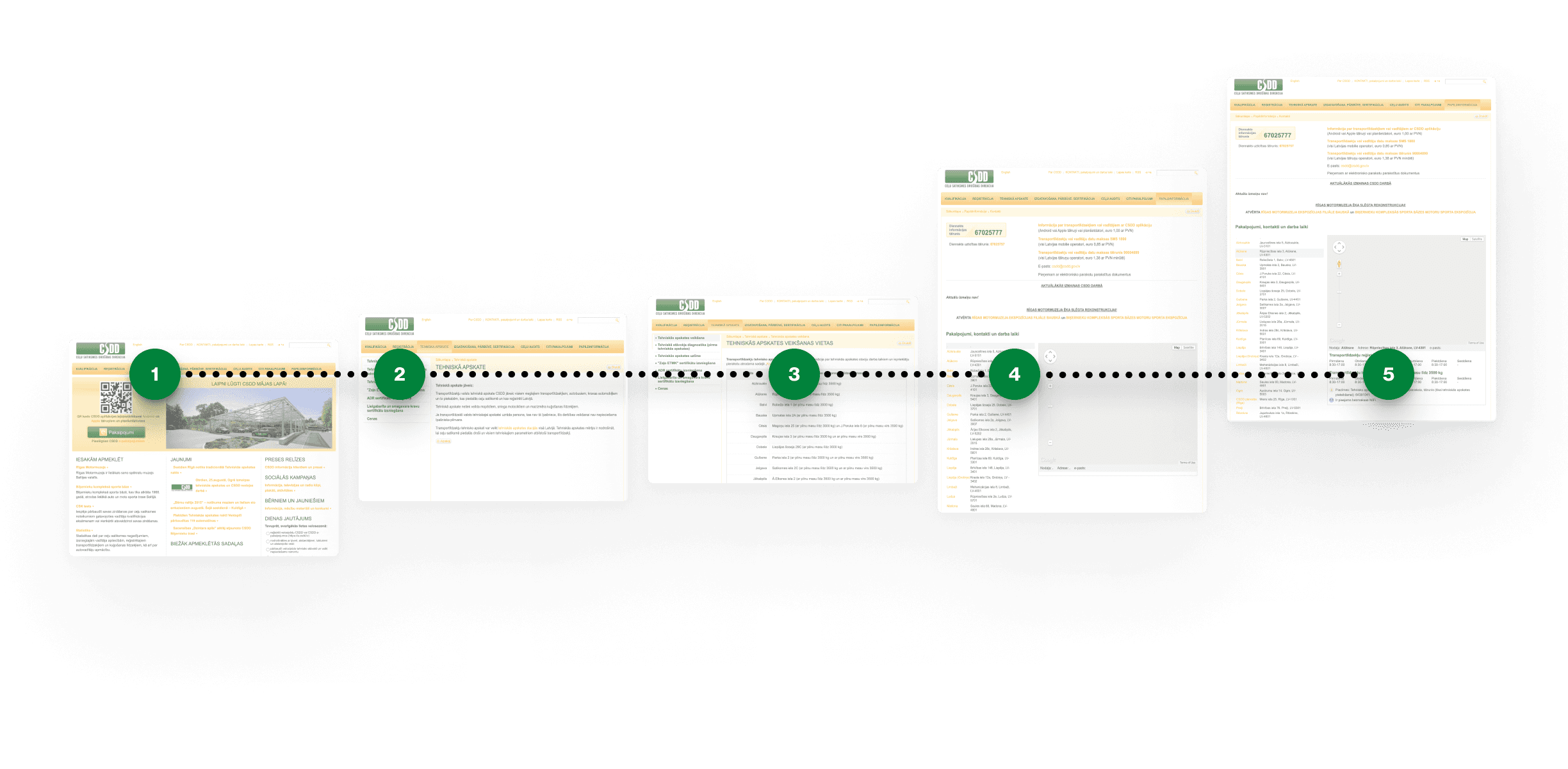
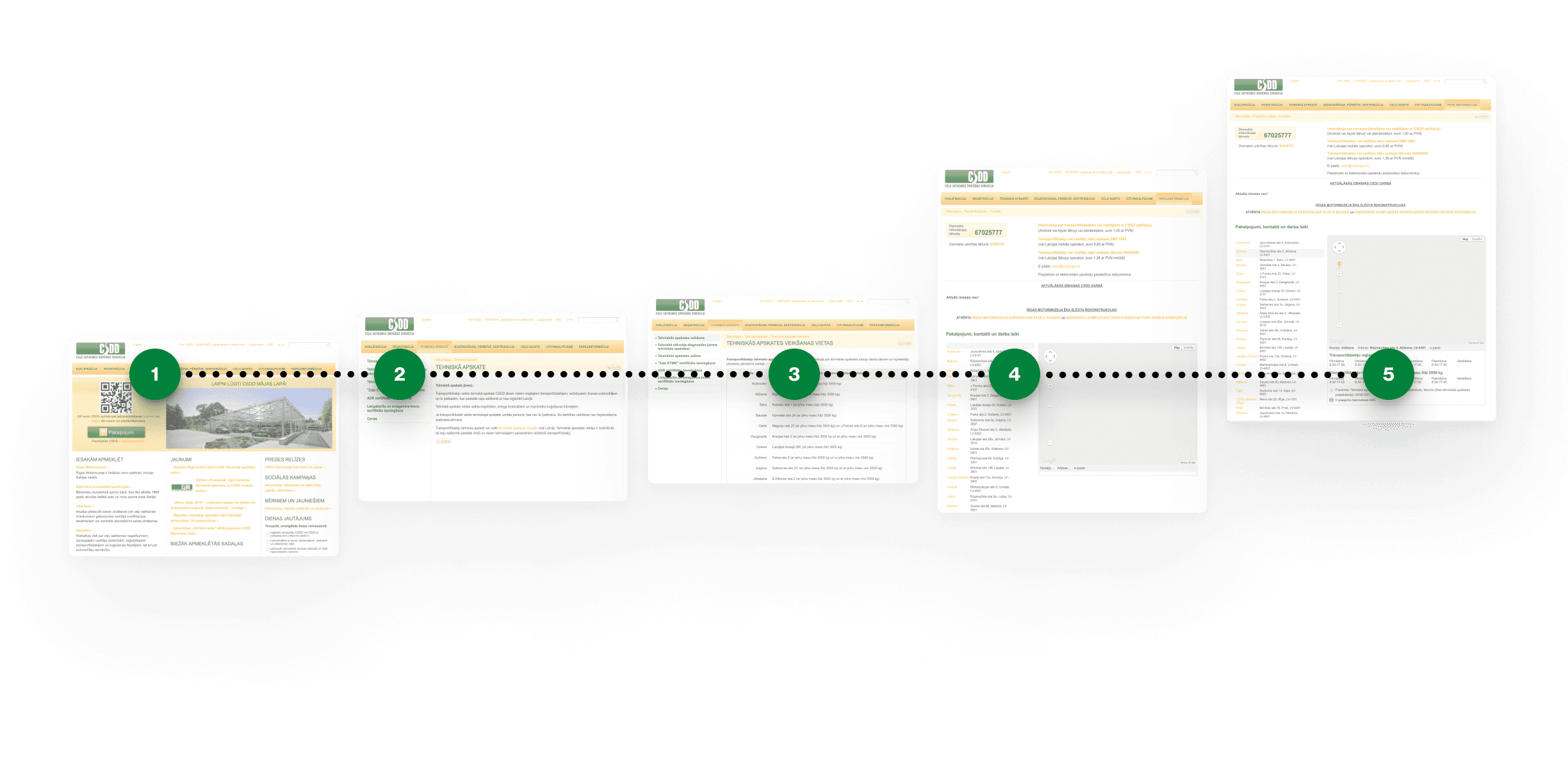
Research had to be run in parallel with early design work — five weeks doesn't allow for sequential phases. We combined analytics, user journey mapping, a content audit, card-sorting, usability testing with real users, and a review of how other European civic platforms had handled similar redesigns.
The public sector often speaks a different language… for example — officially it’s a ‘temporary driving permit’, but people in Latvia call it simply ‘white licence’. If you search ‘white licence’ on the old CSDD site and nothing comes up.
Paraphrased from 05:35 mark, Why Design (episode “Public Service Design in Latvia — Meant for Everyone, Sometimes Incomprehensible”), Latvian Television, 27 Jan 2020

Artis Krilovs,
CEO of WRONG Digital
Key Design Decisions
Five decisions that shaped the final architecture
01
A four-section IA, born from a failed first draft
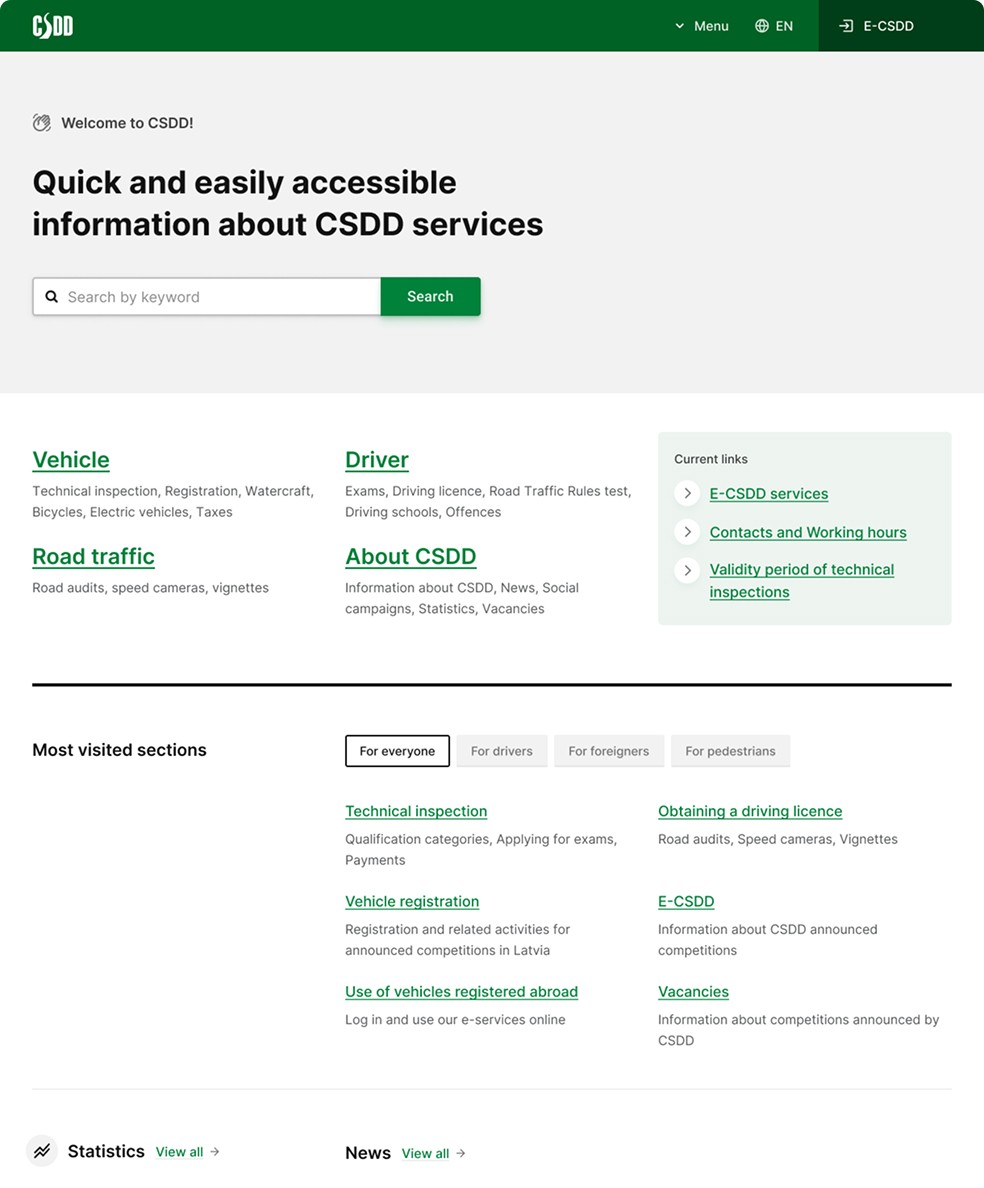
The single biggest structural move — and a compromise. An early version tested a life-event-first landing page with no traditional navigation. It worked for first-time users and broke for returning ones, who knew what they wanted and couldn't find the familiar structure. The four-section IA that shipped — Vehicle, Driver, Road Safety, About Us — kept life-event thinking as the organizing logic while keeping conventional navigation as the wrapper. More than 95% of the existing content fit into those four sections once we removed duplicates and stopped organizing around who owned what. This is the decision the entire redesign rests on; every other choice became easier downstream of it.
02
110+ unique layouts compressed to six — and the bet that came with it
Once the IA flattened, the layouts could too. Every page on the new CSDD.lv uses one of six layout patterns — enough variety to handle the content differences that genuinely exist (a service page differs from a search results page differs from a news item), but not one pattern more.
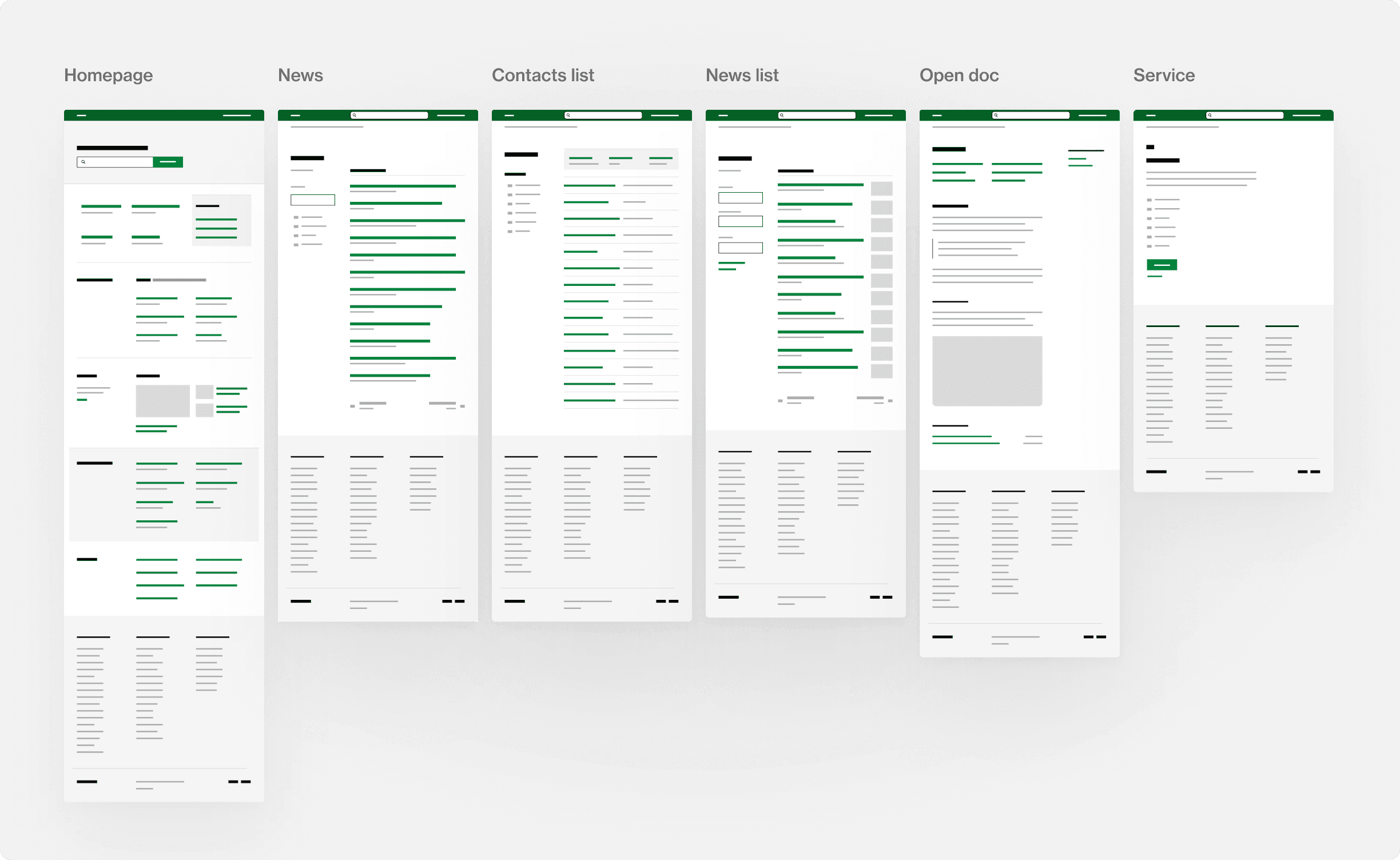
The number isn't a tidying number; it's a long-bet number. A safer instinct would have consolidated to 20 or 30 layouts; six was a deliberate, opinionated cut. The work to arrive at six was synthesis — looking across thousands of pages, separating accidents (different teams, different briefs, different years) from genuine structural patterns. The bet was that these six abstractions sat at the right altitude to absorb whatever CSDD would build on top of them. Ten years and 29 e-services later, the system has not needed a major redesign. The cut held because the abstraction was right.
03
Held the scope to the site. Pushed for transactions. Lost on complexity
CSDD had set the scope at pitch: redesign the public-facing site, leave the e-service transactions out, treat the work as the first step in a phased modernization. I supported it. The IA and content audits I ran with Jānis Veģis in week one confirmed that fixing the surface was already a five-week job, and that the deeper transaction flows needed their own engagement. Internal alignment on six layouts didn't arrive until week two or three — late enough that the cut had been earned, not rushed.
Within that scope, one fight: the e-payment flow. Citizens paid, waited 10–20 minutes for a "payment received" message, then had to complete several more steps before the service was actually requested. It had been designed by CSDD's own engineers without UX involvement, and it was the most-used and least-defended part of the site. I made the case across several meetings — the human cost of the existing flow, multiplied by 300,000 visits a month. CSDD's engineering team held the line: the back-end logic was too entangled to change inside this engagement. We accepted the no and left it out.
Several years later, CSDD redesigned those flows themselves — mostly from a UI angle, not a UX one.
04
Search promoted to first-class navigation
A prominent header search bar that did three things the old one didn't: it accepted everyday phrases instead of demanding the official ones, it forgave typos, and it ignored missing diacritics. Results previewed instantly and suggested next steps inline, so users didn't have to click through to a separate results page. The diacritic handling was the detail that mattered most: typing "tehniska parbaude" without the macrons had to surface the same results as "tehniskā pārbaude," because mobile keyboards and older desktop setups often couldn't produce diacritics easily. In Latvian, exact-match search is a quiet accessibility barrier; fuzzy matching with diacritic folding removed it.
05
Design-system handoff as the actual deliverable
A 4pt grid, a clear type scale, the six-layout library, and accessibility settings that defined how the site handled contrast, focus, tap-target sizes, and spacing. Mobile-first wasn't a separate decision; it was built into the system from the floor up — one-column layouts, 44px minimum tap targets, 7.93:1 contrast on primary actions (well above WCAG AA), underlined links, and visible focus states for keyboard users. The mobile experience raised the floor for every other experience, and the rules that enforced it were what every team that came after us inherited.
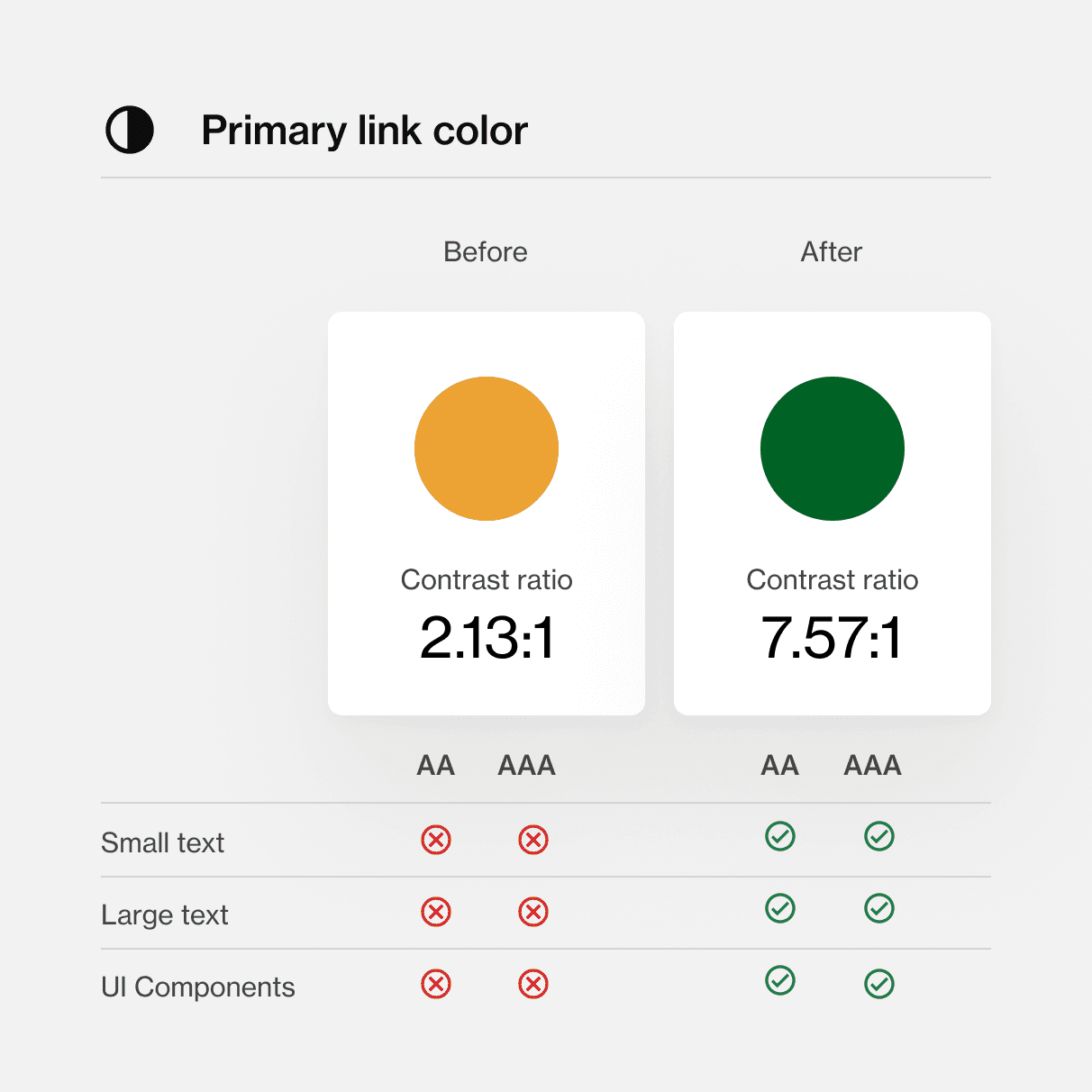
Not a style guide, not a sticker sheet — a working system with use-case documentation for components I knew would be most likely to be misused: tabs, inline warning messages, disclosure patterns. The engagement would end; the system had to survive it. That's the framing I worked against from week one.
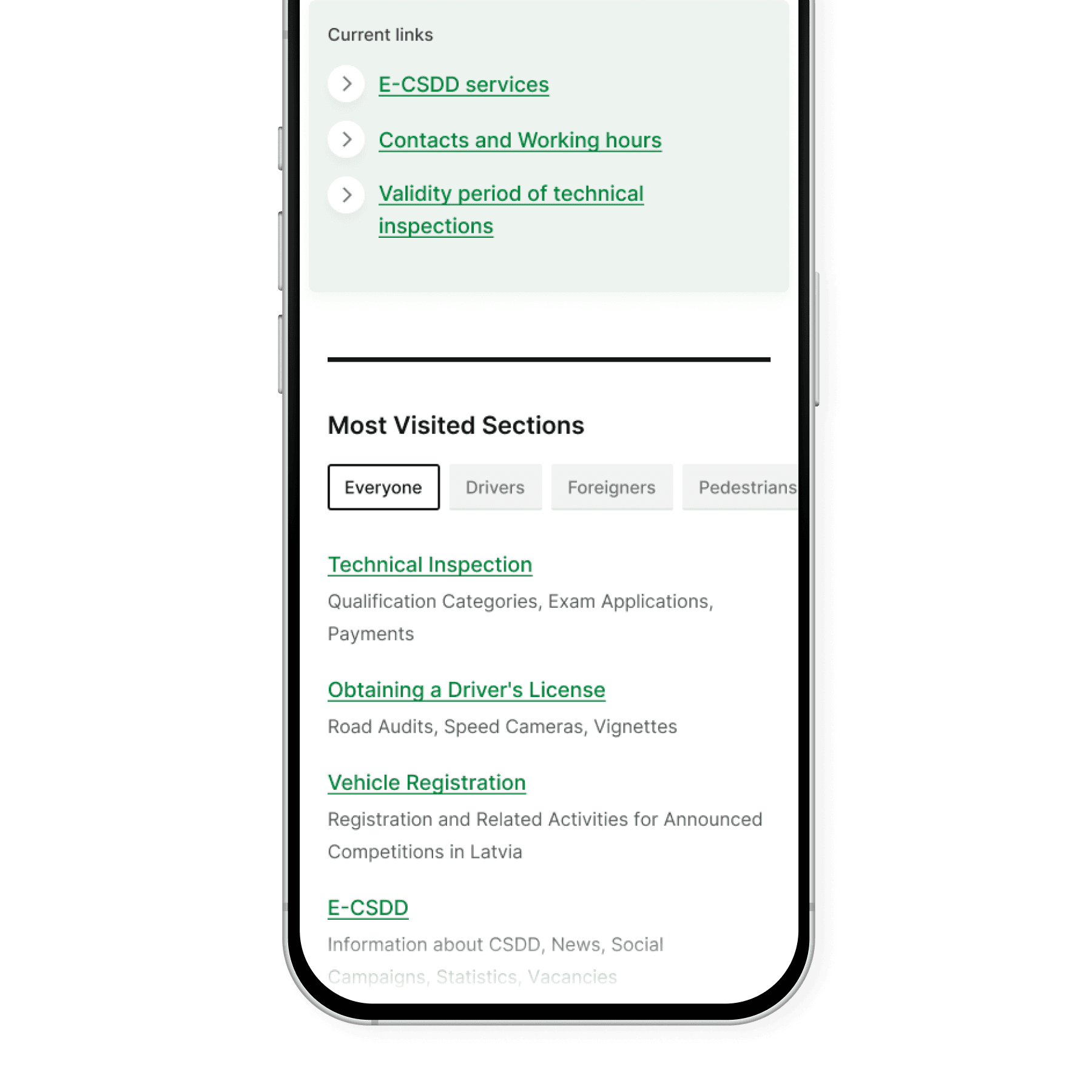
The 18× layout reduction wasn't a cleanup — it was the investment. Fewer patterns held longer than more patterns would have, and every e-service built on top of the system after us got to inherit that decision.
Impact
Why the numbers moved
The numbers below, measured three months after launch, moved because the IA finally matched how citizens were already thinking.
Key KPIs
3:07 → 2:45
Average session length
~12% shorter, 3 months after launch
The session-length decrease is the stat worth pausing on. On most commercial sites, a shorter session is a failure. On a portal like this, it's a success — citizens came to do a specific task, and a good redesign is one where they finish and leave. Nobody wants to spend longer on CSDD.lv than they have to.
The stat that matters most arrived later
The design system we shipped in 2016 is still the spine of CSDD.lv a decade later. The site has grown to 29 e-services in that time — built on the same six layouts, the same 4pt grid, the same tokens we handed over at the end of the five weeks. Registered users climbed from 460,000 to 650,000. That longevity is the real measure of the work; everything else is leading indicators.
Wrong Digital's operating model changed after CSDD
The research-first, analytics-led methodology I'd brought into the agency didn't stay a CSDD story. In the years that followed, it became how Wrong Digital worked — how the agency scoped projects, pitched clients, and structured research. The next major engagement was Liepāja.lv, a city-website redesign run by a different team of designers at the agency. I wasn't on that project. But the approach was the same one I'd introduced. Liepāja.lv won 3rd place at the 2018 Latvian Design Award — the same event at which CSDD.lv received the Accenture Special Award for Digital Business. Two teams, same methodology, two award-winning civic redesigns in one year. The methodology had outlasted my direct involvement — which is the real measure of whether a practice shift took hold.
Learnings
What I took from this work
The design system needed stewardship beyond the handoff
I'd written documentation for every component and delivered presentations to CSDD's team specifically about the patterns most likely to be misused — tabs, inline warning messages, the disclosure hierarchy. In our last alignment meetings, stakeholders started asking questions about these exact components. As I answered, I realized something uncomfortable: they were already implementing them in ways we hadn't discussed, outside the documented use cases. The drift had started before we'd finished handing over. The lesson wasn't that I should have documented more — the documentation was fine. The lesson was that for a system destined to run for a decade, the handoff itself is inadequate as a governance model. I needed to have argued earlier — at the scoping stage, not at the end — for structural stewardship: a nominated design owner on the CSDD side, quarterly reviews, a formal channel for new patterns. I've pushed for this earlier on every handoff since.
Research speed has a floor
Five weeks is fast for a platform this broad. We ran usability tests with 12 participants, card-sorting with 14, and analytics across nine months of data — enough to catch the major patterns. But the edge-case users we only met after launch — users with screen readers navigating the new layout, users on very old Android devices hitting rendering quirks, users whose workflows sat between our four content sections rather than squarely inside one — were exactly the users the IA most needed to hold for. I don't think I could have found them in five weeks. What I could have done was flag the gap explicitly at handoff: "these users exist, we haven't met them yet, here's what to watch for in the first quarter post-launch."
The descope decisions mattered more than the design decisions
Looking back, the work held for ten years largely because of what we chose not to do. Rebuilding the e-service transactions would have consumed the entire five weeks; we would have shipped a half-redesigned site with inconsistent patterns and no design-system foundation. Keeping the transactions untouched meant the six layouts, the IA, and the accessibility tokens got the attention they needed. Scoping under pressure is often framed as the weaker form of design work — what you do when you can't do the real thing. On this project it was the opposite. The constraints forced the decisions that made the system durable.